Draft Strategy From The 1.07 For 2026 Fantasy Football: Anchoring Around Jonathan Taylor
Chris Allen breaks down the optimal way to approach your 2026 drafts from the 1.07.
I didn't know folding laundry could be a point of contention until I got married. My shirts are nice and crisp as I fold them a certain way (i.e., the right way). Apparently, other methods were ... more preferred by my wife. Of course, I noted there wasn't a difference in the result and wound up doing the rest of the load all by myself.
Now, the takeaway isn't that I made a rookie mistake by asking questions. I was young. It's her world. I'm just living in it. Anyway, failing to see the disparity in approaches was my downfall. Drafting from the 1.07 in 2026 fantasy football may seem similar to the 1.06. It's just one spot over. It's just one less player you'll get to draft. However, when you dive into the details, there's enough to make you reconsider.

Join Our Newsletter
Trusted by 400,000+ fantasy football players. Get access to Fantasy Life's free award winning newsletter and tools, all in one step.
By registering or logging in, you agree to our Terms of Use and Privacy Policy.
Tips For The 1.07 In 2026 Fantasy Drafts
What It Takes to Be the Overall RB1
After doing a similar study on the anatomy of the overall WR1, switching to RBs was the next step. But even while glancing through some film, the starkness of what’s required to be the best at the position stood out.
I lost a championship in one of my dynasty leagues because of this game. Anyway, Derrick Henry is one of the prime examples of our current greats. But even for all of his brute force and speed, fantasy gamers need more than just pure runners.
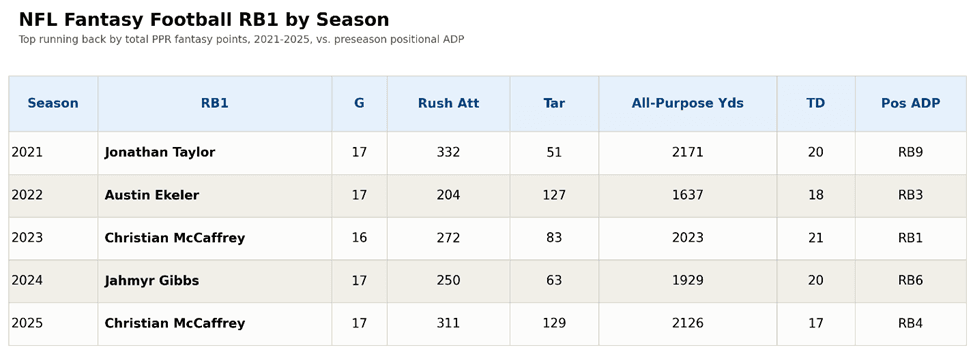
Like the discussion of elite QBs needing the passing acumen and mobility to boost their status, RBs have to demonstrate a comparable dual-threat ability. It’s not enough to just be the short-yardage option or involved on passing downs. The more often an offense has an RB on the field, the greater their value. Said another way, a rusher’s talent becomes obvious as their workload increases.
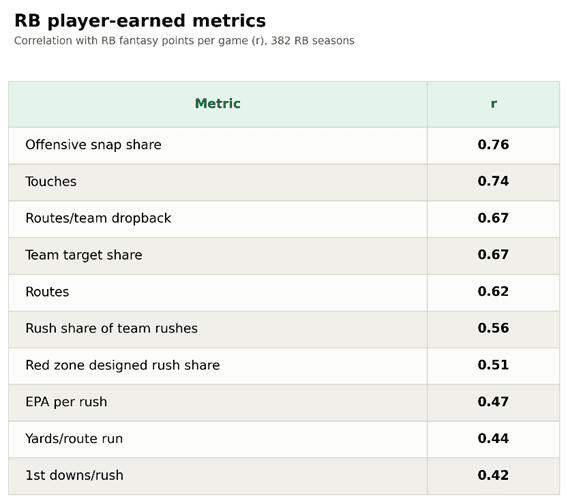
I used the last 10 years of data to isolate the usage metrics with the highest correlation to fantasy points. As always, volume (i.e., touches) is king. But seeing target rate and routes right behind the main duties of an RB shouldn’t be too surprising. Increased opportunities lead to higher yardage and touchdown totals. However, like any other skill player, their situation is what gives them the best path to fantasy stardom.
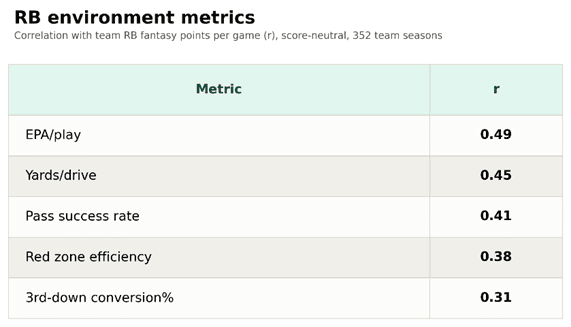
Team passing success rate having the most impact on RB scoring wasn’t on my bingo card. But the more I thought about it, the more it made sense. A pass is inherently more efficient than a run. They (generally) go farther and take less time off the clock. Accordingly, more efficient passing would lead to more plays in their opponent’s red zone. In other words, ironically, it’s a team’s aerial attack that “carries” an RB to better scoring situations. In either case, the real value in all of this is if we can see what’s predictable year over year.
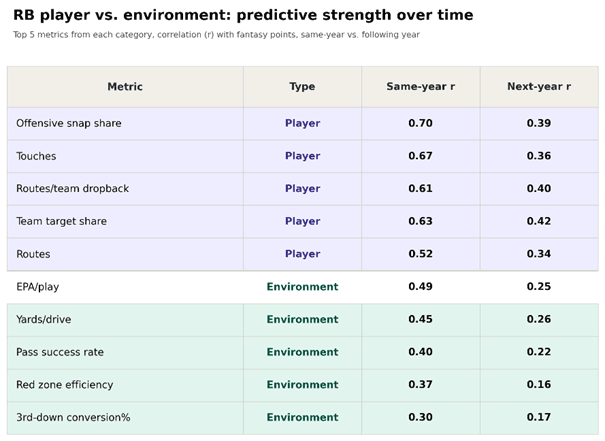
We don’t have the strongest signal with the environmental stats, but they’re enough to devise a heuristic or rule of thumb. Because we know the talent of an RB isn’t enough on its own. We’ll get spurts of top-12 results, but their surroundings will drag them down. Ask either of the Carolina RBs. So, instead of using my qualitative thoughts as a guide, I put some numbers to each offensive environment.
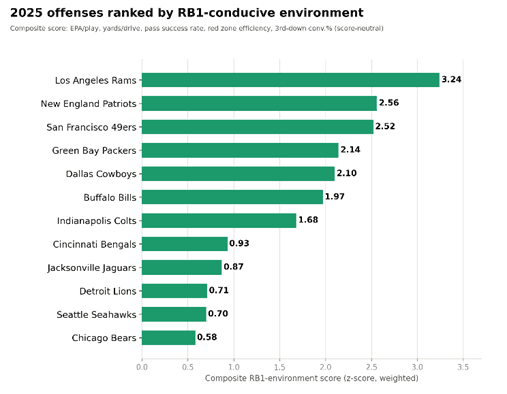
Both teams that made it to the Super Bowl and multiple playoff teams held the best composite scores after weighting each of the environment metrics. That’s not news. But at least the process passes the sniff test. Now, let’s spin it forward for 2026. And based on current ADP, a few names stuck out as undervalued given their talent and situation.
- D’Andre Swift: 59.7 (Consensus ADP)
- Bhayshul Tuten: 62.7
- Jadarian Price: 69.9
Swift already has the environment element working in their favor. We’ll be in Year 2 of the Caleb Williams-Ben Johnson relationship after a productive (read explosive) first season together. A step forward for Williams as a passer puts Swift in line for more money touches, as he handled 61% of the Bears’ goal-line attempts.
Now, let’s draft!
For reference, here’s the format I chose in our Draft Champion tool:
- 12 teams
- Standard
- 1QB, 2RBs, 2WRs, 1TE, 1FLEX, 1K, 1DST
You’re On the Clock at 1.07!
I did an AMA on Reddit on Monday (nice community over there; had a blast) and somebody (u/kjkartik) asked me to do one of these using standard league settings. I haven’t used that scoring format in …awhile. But let no one say I’m not a man of the people. Besides, I wasn’t ready for what the Draft Champion tool gave me once it got to the 1.07:
- 1.01: Bijan Robinson
- 1.02: Jahmyr Gibbs
- 1.03: Christian McCaffrey
- 1.04 - Ja'Marr Chase
- 1.05 - Puka Nacua
- 1.06 - James Cook
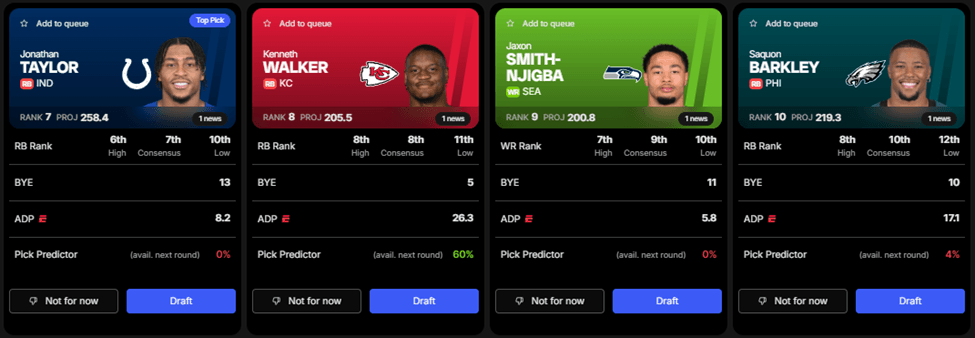
I’ve been so used to fighting for WRs right out of the gate, that seeing the opposite feels like I’m playing a different game. Four RBs before the seventh-overall pick? Madness! And the Draft Assistant is in on the absurdity, too.
However, I shouldn’t be surprised. With the removal of receptions as a scoring mechanism, receivers don’t have the same edge. Using a dataset going back to 2015, catching the ball is worth ~3.2 times more than carrying it in PPR leagues. That same multiplier drops to 1.6X in standard scoring. WRs don’t feel the same impact (2.7X in PPR to 1.7 in standard), but that doesn’t stop us from coming to the wrong conclusion about how to adjust to this scoring system.
- RBs: 18.1% (share of points coming from receptions)
- WRs: 35.6%
My first intuition, aided by the Draft Assistant, was to focus on the RB position and figure out WRs later. But rushers aren’t gaining value by eliminating the award for a reception. It’s just that they’re losing less. Yes, receivers feel the brunt of the shift. But Ja’Marr Chase is still likely to outscore Garrett Wilson. Or, said another way, we should still want starters (RBs AND WRs!) that will give us bigger point totals each week.
However, I’ve already talked about Jaxon Smith-Njigba. And after Chase and Puka Nacua, the Seahawks’ WR1 would be my first click if I’m looking for a WR. But if we’re putting rushers and receivers on an equal playing field (scoring-wise), the Colts’ RB1 becomes a viable option from the seventh spot.
By Week 10, Jonathan Taylor had five weeks where he scored more than one touchdown. The Colts’ offense was a juggernaut, and Taylor had nothing better to do on Sundays than plow through defenders. But everything changed after Daniel Jones got hurt.
- Weeks 1-10: 71.3% (Rushing Rate), 52.9% (Success Rate), 5.08 (adj. yards after contact per att.)
- Weeks 11-17: 87.6%, 41.7%, 2.49
The only thing that improved for Taylor was his target rate. But with the offense dropping from first to worst, the minor bump in touches didn’t matter. So, if you’re in the camp of “if Jones is healthy, Taylor will roll again,” I’ve got good news for you.
The steady drumbeat out of Colts’ camp has been a positive one. It’s a testament to modern sports medicine, lending credence to the idea that Indy’s offense has a shot at reclaiming some of last season’s magic. I don’t expect Taylor to stroll into the end zone three times a game, but his control over the backfield in an efficient offense is the right mix of talent and situation we’re looking for at the 1.07.
The Rest of the Early Rounds When Drafting From The 1.07
So, I headed into the second round with my “WRs still matter” mantra stuck in my head, ready to take the best receiver still on the board. But the Draft Assistant threw me another curveball, leaving CeeDee Lamb, Jeremiyah Love and Brock Bowers to choose from.
Again, I’m used to 0.5 or full-PPR settings. But, more importantly, we’ve got a new version of the Brock Bowers debate. The case for Bowers, in any other format, hinges on his ability to earn targets. He’s the WR13 by projected volume. But if the bonus for catching the ball goes away, TEs stand the most to lose.
- RBs: 18.1% (share of points coming from receptions)
- WRs: 35.6%
- TEs: 39.1%
I expanded the earlier study and found that TEs are the most PPR-dependent position. On the whole, they don’t have double-digit aDOTs, enabling higher yardage totals. Once more, my intuition was to avoid using high draft capital to fill that need. I can add one later. But a deeper look brought me back around to the idea.
- TE1: 6.2 (receptions per game), 12.2 (yards per game), 0.57 (TDs per game)
- TE5-8: 4.4, 11.3, 0.38
- TE9-12: 3.9, 11.1, 0.29
The increased looks to elite TEs aren’t just chances to add more points one catch at a time. But they also accumulate more yards, too. And if those targets are in the red zone, extra shots at scoring a TD.
To be honest, I couldn’t bring myself to take Bowers over Lamb. However, as I was putting together two teams, I used an early-round pick to secure one of my favorite targets at the position.
- My Team (1): Jonathan Taylor, Chase Brown, Malik Nabers, Colston Loveland, Ladd McConkey, Jameson Williams
- My Team (2): Jonathan Taylor, CeeDee Lamb, Javonte Williams, Zay Flowers, Jayden Daniels, DJ Moore
Mid-Round Pitfalls At The 1.07
As always, let’s take a big-picture look at Team 2 and see where we need to focus in the middle rounds.
- Need a TE1
- Need depth at RB
- Want WR depth
Harold Fannin, Sam LaPorta and Kyle Pitts were still free agents, giving me pause on checking off the TE1 box at the start of the middle rounds. Plus, yet again, the Draft Assistant had me reconsidering everything.
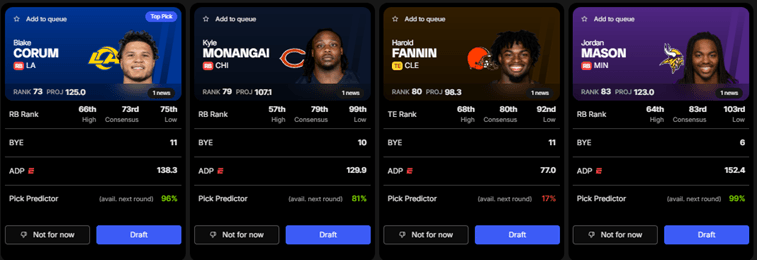
Look at the fantasy football ADPs for Corum and Monangai. Everywhere else, we’re waiting until the double-digit rounds to pick them up. Here, we’re at RB33 by the seventh round. I panicked and thought something was wrong. But reliance on RBs is stronger in standard. Besides, let’s go back to our discussion about running backs to see if either rusher would be tough to stomach as an RB3.
- Rushing Rate: 35% (Corum), 39% (Monangai)
- Target Share: 3%, 6%
- Goal-Line Share: 42%, 38%
Both had the talent to challenge their respective starter for base-down work and touches from inside the five-yard line last season. Plus, they were on offenses with the ecosystem to produce top-12 RBs despite the workload split. In other words, they match the profile of an ideal spot starter with the contingent upside for RB1 output should their volume increase.
Building a Championship Fantasy Football Roster From the 1.07
So, after starting with Taylor from the 1.07, let’s look at our two teams after the draft strategies diverged.
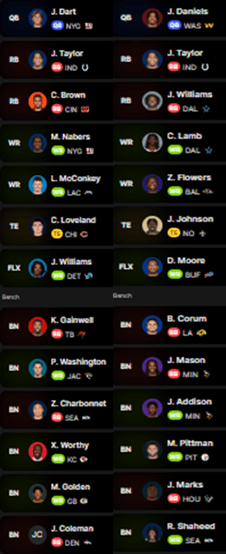
There’s enough to like between both rosters, independent of your preferred draft strategy. Early-round TE for Team 1 put more pressure on the receivers to perform early. Meanwhile, Team 2 needs both onesies to show off on-field talent we only saw in spurts last year. Anyway, the analyzer agrees that the pros and cons of each squad are enough for a playoff run.
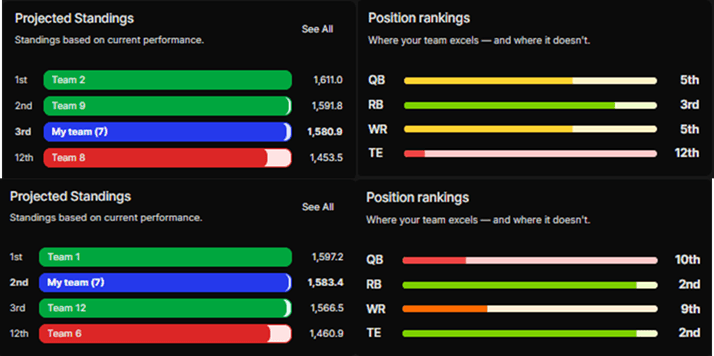
However, as I’ve said in the past, we’re not trying to win a mock draft. Your leaguemates are going to have different tendencies. Your decisions while the clock is ticking are going to feel harder. But if you apply each lesson, from how to value positions at the 1.07 to re-evaluating your team once you get into the middle rounds, the process for finding the best path through the draft will become easier to see.
Join Our Newsletter
Trusted by 400,000+ fantasy football players. Get access to Fantasy Life's free award winning newsletter and tools, all in one step.
By registering or logging in, you agree to our Terms of Use and Privacy Policy.
Players Mentioned in this Article




Published Updated